
A Comprehensive Resource from PCM Encore
Tax Planning Guide for Technology Professionals
Introduction
For high-achieving professionals in the technology sector, compensation often extends well beyond base salary, encompassing complex equity structures, deferred income arrangements, and advanced retirement planning opportunities. Strategic tax planning is essential not only to minimize tax liability but also to align financial decisions with long-term wealth goals. This guide outlines key areas of focus for optimizing tax outcomes across the full spectrum of tech compensation.

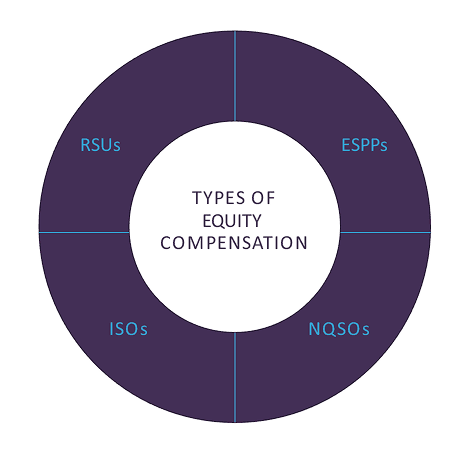
Equity compensation, whether in the form of Restricted Stock Units (RSUs), Incentive Stock Options (ISOs), Non-Qualified Stock Options (NSOs), or Employee Stock Purchase Plans (ESPPs) can be a powerful wealth-building tool. However, each type carries distinct tax implications. Strategic planning around the timing of vesting, exercising, and selling equity—especially in conjunction with market conditions and personal income levels—can significantly impact after-tax outcome.
Employee Stock Purchase Plans (ESPPs)
ESPPs allow employees to purchase company stock at a discount in an easy and convenient manner using after-tax payroll deductions. When individuals participate in an ESPP, two main tax events need consideration: the purchase of the stock and the eventual sale or exchange.
The discount received on the initial stock purchase is not taxed at the time of purchase if the plan is qualified. However, when the stock is eventually sold or exchanged, the discount may be subject to taxes. The tax consequences upon selling ESPP shares depend on the holding period of the stock. Qualified dispositions typically help lower the amount subject to ordinary income tax, potentially granting more favorable tax treatment than disqualified dispositions.
To receive preferential tax treatment, the stock must be held for at least one year from the purchase date and two years from the offering (grant) date. If these requirements are satisfied, the sale will receive favorable capital gains tax treatment. In a qualified disposition, participants will be taxed at ordinary income rates for the allotted plan discount based on the lesser of the discount percentage (typically 15%) multiplied by the Fair Market Value (FMV) on the grant date, or the actual gain based on the spread between the sale price and purchase price.
Any additional profit due to appreciation is taxed at preferential long-term capital gains rates. If shares decline in value and employees sell them at or below the purchase price, they may realize a capital loss.
Should the disposition be disqualified (sold before meeting the holding periods), no preferential tax treatment is applied to the discount. Ordinary income tax rates will be assessed on the difference between the actual purchase price and the market price on the date of purchase, often called the "bargain element." This ordinary income is taxed regardless of whether the individual sells the stock for a profit or a loss. Any gain above the FMV on the purchase date is then taxed as a capital gain (short-term or long-term, depending on the holding period).
Restricted Stock Units (RSUs)
RSUs are a form of equity compensation issued to employees in company shares. These shares come with specific restrictions and vesting criteria, hence the name "restricted." Because full ownership is conditional, RSUs are not typically taxed at the time of the grant. When RSUs vest, they are considered income and trigger ordinary income recognition on the fair market value (FMV) of the shares at the time of vesting, minus any amount the participant paid for them (which is typically zero).
This amount is subject to federal, state, and payroll taxes, just like a cash salary, regardless of whether the individual sells the shares immediately upon vesting. For amounts under $1 million, the default federal supplemental withholding rate is 22%. Employers generally satisfy this obligation by selling a portion of the vested shares (a "sell-to-cover" transaction) before delivering the remaining shares to the employee's account. However, the actual tax liability depends on an individual's total taxable income; participants may owe additional tax if the default withholding rate is lower than their effective tax rate.
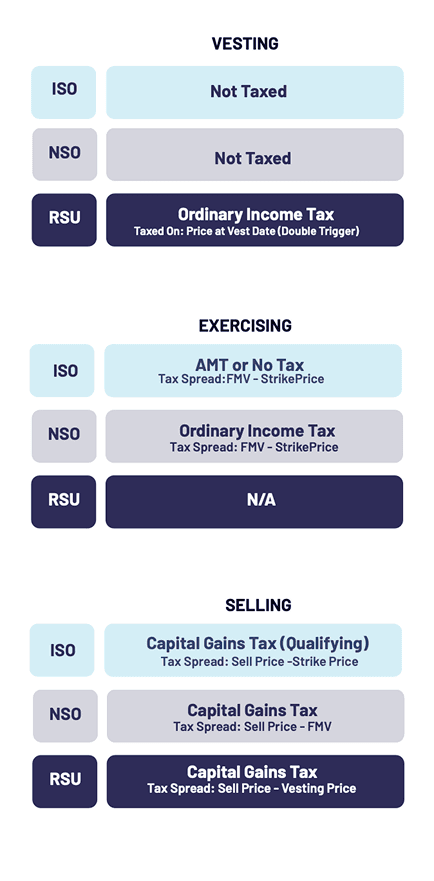
The simplicity of RSUs limits planning opportunities compared to stock options. The decision of when to sell RSUs depends on financial goals, liquidity needs, market outlook, and tax planning. If employees hold the shares after vesting, subsequent appreciation is treated as a capital gain. Holding shares for longer than one year after the vesting date allows for preferential long-term capital gains tax rates. However, this strategy carries the risk of a decline in stock value and potential portfolio concentration issues.
Stock Options
Stock options grant employees the right to buy shares of company stock at a fixed price, known as the "strike" or "exercise" price. Two types of employee stock options are available in the U.S.: Non-Qualified Stock Options (NSOs) and Incentive Stock Options (ISOs). While both function similarly, they differ significantly in tax treatment. Generally, stock options may be taxed at two points: first when they are exercised (purchased) and again when the shares are sold.
Non-Qualified Stock Options (NSOs)
For NSOs, taxes are triggered both upon exercise and when the shares are sold, often leading to higher total taxes compared to ISOs. Upon exercise, the spread—the difference between the exercise price and the FMV—is taxable as ordinary income. Companies are required to withhold federal, state, and payroll taxes, just as they would with a cash bonus.
Because taxes are due at the moment of exercise, individuals must often decide between a "cash exercise" (paying the strike price and taxes out of pocket) or a "cashless exercise" (selling enough shares immediately to cover the costs) (covered later in Part 3 of this guide). A significant risk exists if participants exercise NSOs and hold the shares as they remain liable for the tax on the exercise-date FMV even if the stock price subsequently declines.
The FMV at the time of exercise becomes the cost basis for the shares. Any subsequent appreciation realized upon the sale of the shares receives capital gains treatment. If the shares are held for one year or less after the exercise date, any gain is taxed as a short-term capital gain at ordinary income rates; however, if the shares are held for more than one year, the appreciation qualifies for preferential long-term capital gains tax rates.
Incentive Stock Options (ISOs)
Unlike NSOs, ISOs can qualify for special tax treatment. Instead of the spread being taxable as ordinary income at exercise, it is included in income as part of an Alternative Minimum Tax (AMT) calculation. The AMT is a parallel federal tax system designed to ensure that taxpayers pay at least a minimum amount of tax, regardless of deductions or exclusions. Individuals must pay whichever system yields the largest tax liability.
If the AMT is triggered—as is often the case with large ISO exercises—an employee will receive a future Minimum Tax Credit (MTC) that can be used to reduce future regular tax liability. Strategic timing around income management and AMT considerations is important, as AMT typically applies only if participants buy ISOs and do not sell them in the same tax year.
To take advantage of potential tax savings, specific holding period requirements must be met. To qualify the shares must be held for at least two years from the grant date, and the shares must be held for at least one year from the exercise date.
If both conditions are met, the difference between the Tax Spread: Sell Price – Strike Price sale price and the price paid for the ISOs is subject to preferential long-term capital gains tax rates. If the period requirements are not met (a disqualified disposition), ordinary income is recognized on the difference between the strike price and the FMV at exercise. In both instances, any subsequent appreciation after the exercise date receives capital gains treatment.
Vesting Schedules and Exercise Timing: Planning for Tax Efficiency
Understanding the mechanics of vesting, when equity compensation is transferred to an employee's ownership, and when taxable events occur are essential for effective planning. When vesting and exercise decisions are coordinated with lower-income years, charitable giving, or other planning strategies, tax efficiency and optimization are enhanced. Taxable events typically occur at vesting (for RSUs) or exercise (for options), making it essential for participants to anticipate and plan for the associated income.
Vesting
The timing of vesting, exercising, and selling shares carries important tax and financial planning implications.
As noted in Part 1 of this guide, when employees are granted stock options, they do not receive actual shares of the company. Instead, participants receive the right to buy a set number of shares at a predetermined strike price in the future. Exercising these options is the formal process of purchasing those shares.
In contrast, individuals who receive RSUs are granted shares that they can sell, exchange, or gift once they are delivered. Unlike stock options, employees do not need to purchase RSUs; they simply wait for the units to vest.
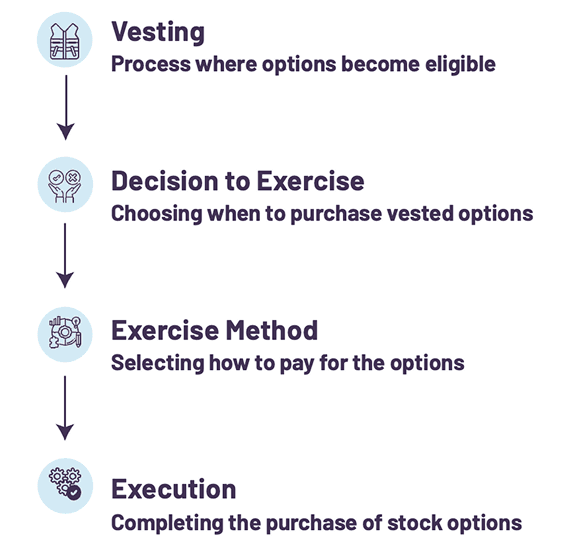
Vesting refers to the period during which employees become eligible to exercise their options. The vesting schedule, which outlines the timeline and conditions for vesting, is typically defined at the time of the option grant. There are three common types of vesting schedules: time-based (graded), milestone-based, and hybrid.
Time-based (Graded):
Employees gradually gain rights to their equity over a set period (e.g., monthly, quarterly, or annually over a few years). Most graded schedules incorporate a vesting cliff, typically at the one-year mark. If an individual leaves before the cliff, all options or units are forfeited.
Milestone-based:
Employees earn shares after the company achieves specific goals, such as hitting a valuation target or completing a major project. This is less common than time-based models.
Hybrid Vesting:
This model requires participants to satisfy both a time-based requirement and a milestone (such as an IPO or acquisition) before receiving their shares.
Exercise Methods & Rationale
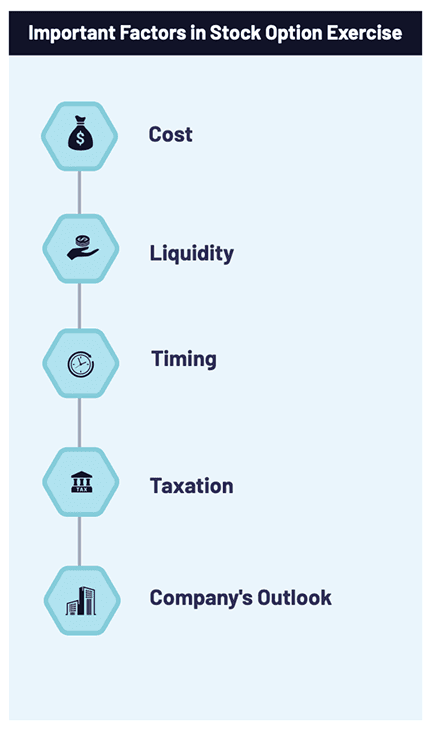
Once stock options vest, employees must evaluate factors such as market price, liquidity, tax implications, and cost before deciding to exercise. Understanding when and how to exercise stock options should be aligned with an individual's goals and unique financial situation. Strategic timing can help ensure financial strategies and tax planning opportunities are optimized.
When to Exercise
To manage risk, diversify assets, and smooth out tax liabilities, employees can spread exercises over time so that if one option doesn't perform well, they have other options to balance it out. The best approach depends on the specific type of option. Common strategies include:
- Exercise Spreading: Similar to dollar-cost averaging, using a rolling exercise strategy to exercise vested options over a pre-determined schedule can help avoid "timing the market" poorly.
- Income Management: Strategically exercising options during years of lower income, such as a sabbatical or the first year of retirement, can reduce the overall tax liability by keeping individuals in a lower tax bracket.
- AMT Balancing: ISOs can trigger the AMT if exercised and held. Multi-year planning helps avoid excessive AMT exposure, especially for large ISO grants.
- Deciding not to exercise: Employees don't always need to exercise their stock options as they vest. If the options are "underwater", meaning the strike price is higher than the current market price, it is beneficial to wait until the market has stabilized. Individuals may also choose against exercising options if they lack liquidity or if the stock is considered too risky.
Advanced Timing Strategies
- Early Exercise: Some companies provide employees with the opportunity to exercise their equity early, which can unlock significant future tax benefits.
Early exercising allows participants to purchase shares before they vest, typically at a time when the strike price and the Fair Market Value (FMV) are nearly equal. Because there is little to no "spread" at this stage, the transaction triggers minimal immediate tax liability.
For early exercise to be effective, individuals must file a Section 83(b) election with the IRS within 30 days of the exercise date (covered later). There are no extensions or exceptions to this rule. This election formally notifies the IRS that the participant wishes to be taxed on the value of the shares at the time of purchase rather than as they vest.
Early exercise can offer tax advantages, but it carries significant risks. Shares purchased early remain subject to the original vesting schedule, and if individuals leave before full vesting, the company typically has the right to repurchase unvested shares at the original price or current fair market value. Taxes paid under an 83(b) election are irrevocable, meaning individuals cannot recover them if the shares are forfeited or the company's value declines. Additionally, early exercise requires a cash outlay for shares that may remain illiquid for years, creating concentration risk if the company never reaches a liquidity event or if the shares fail to appreciate. - Exercise Upon Departure: Most companies provide a Post-Termination Exercise Period (PTEP). This is the window of time individuals have to purchase their vested shares before they are forfeited and returned to the company's equity pool. Understanding the specific length of a company's PTEP is a critical component of assessing an overall equity package.
Many companies have recently extended their PTEP windows (sometimes up to several years) to be more employee friendly. For ISO holders it is important to note the IRS imposes a 90-day statutory limit following the last day of employment to maintain tax benefits. If the company allows an extension beyond 90 days, the ISOs are automatically converted to NSOs for tax purposes.
How to Exercise
Depending on the company and the available brokerage platform, there are several ways participants can fund an exercise:
- Exercise and Hold (Cash Exercise): Employees use their own capital to buy company shares and hold them for potential long-term appreciation. This is standard method of exercising stock but it is also the riskiest method because employees are not guaranteed to make a profit (or even get their money back). In addition, employees may face liquidity and concentration risk as funds are tied up in company shares until they are sold. However, it allows for the possibility of significant long-term gains if the stock appreciates.
- Exercise and Sell to Cover (Cashless Exercise): Participants exercise their options and immediately sell just enough shares to cover the purchase price and anticipated tax liabilities. This enables individuals to acquire a smaller number of shares without out-of-pocket costs, hedging against liquidity and concentration risk while maintaining a stake in the company. Employees with limited cash flow that still want to acquire shares without upfront costs may find this beneficial.
- Exercise and Sell All (Cashless Exercise): Employees exercise their options and immediately sell all resulting shares. This strategy is suitable for employees with immediate cash needs that want to quickly convert their stock options into liquid assets. By selling all shares immediately, employees can eliminate the risk of future stock price fluctuations while providing more predictable tax implications, as the entire gain or loss is realized in the year of sale.
- Exercise and Reinvest: Similar to "Exercise and Sell All", participants exercise their options and immediately sell all resulting shares, but instead of holding cash individuals reinvest the proceeds into a diversified portfolio of other stocks and assets. This approach helps maintain market exposure while reducing the risk associated with concentrating wealth in a single company.
Advanced Tax Elections: Section 83(b) & 83(i)
Strategic planning for equity compensation often involves specialized tax elections that allow participants to manage the timing and nature of their tax obligations. Two key provisions—Section 83(b) and Section 83(i)—offer distinct opportunities to optimize financial outcomes, although they serve different purposes and operate under separate eligibility rules. Understanding how these elections work is essential for maximizing the long-term value of equity awards while avoiding unexpected tax liabilities.
Section 83(b): A Section 83(b) election allows employees to pay income taxes on the fair market value of their shares at the time of grant (for Restricted Stock Awards) or at the time of early exercise (for stock options), rather than waiting for the shares to vest. By making this election, participants lock in a lower valuation for tax purposes, which can result in significant tax savings if the stock appreciates over time. Furthermore, the holding period for long-term capital gains begins on the date of the election, which often allows future appreciation to be taxed at more favorable rates rather than as ordinary income.
The election must be filed with the IRS within 30 calendar days of the stock transfer date. This deadline is strictly enforced with no permitted extensions. While the tax benefits are compelling, the 83(b) election is not without risk, as any taxes paid are irrevocable.
If the stock is subsequently forfeited before vesting or if the company's valuation declines, individuals cannot recover or refund the taxes already paid to the IRS. Additionally, it is important to note that RSUs are not eligible for 83(b) elections because no property is technically transferred to the employee at the time of the grant.
Section 83(i): Section 83(i) is a more specialized provision designed to address the liquidity challenges faced by employees of private companies who may owe taxes upon vesting or exercise but cannot yet sell their shares. This election allows qualified individuals to defer federal income tax for up to five years on qualified stock received from exercised options or settled RSUs. The deferral period ends at the earliest of five events: the stock becomes transferable, the company goes public, the employee sells the shares, the individual becomes an "excluded employee," or the five-year anniversary of the election is reached.
To qualify for an 83(i) election, both the employee and the employer must meet strict criteria. The individual cannot be a current or former CEO, CFO, 1% owner, or one of the four highest-paid owners of the corporation. Simultaneously, the company must remain private and must have granted equity to at least 80% of its full-time U.S. workforce within the same calendar year.
Participants should be aware that a Section 83(i) election only defers federal income tax, while FICA taxes (Social Security and Medicare) remain due at the time of vesting or exercise. Furthermore, making an 83(i) election on an ISO will cause that option to lose its statutory status, reclassifying it as a NSO for all future tax purposes. Like the 83(b) election, the 83(i) filing must be completed within 30 days of the vesting or exercise date to be valid.
Choosing between Section 83(b) and Section 83(i) depends on several factors, including the company's stage of growth, the individual's financial situation, and the expected timeline for liquidity events. Section 83(b) is generally more beneficial for employees in early-stage companies who expect significant appreciation and possess the liquidity to pay taxes upfront on a lower valuation. By contrast, Section 83(i) is better suited for employees in later-stage private companies who anticipate a future IPO or acquisition but need time to manage their cash flow before facing a substantial tax bill on high-value shares.
Managing Concentrated Stock Positions
After an IPO or a long, successful career, employees may have built a large equity holding in their company. As positions grow in value over time they may represent a significant portion of an individual's overall wealth. Concentrated stock positions, those that make up a large percentage of the total portfolio value, can feel like an anchor given potential exposure to higher volatility and complications when selling due to tax implications. Specialized tax-deferral and mitigation strategies can help transition concentrated positions into diversified portfolios.
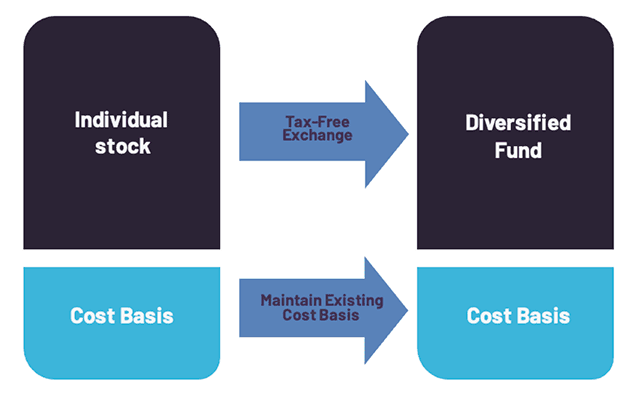
Exchange funds: Exchange funds solve one specific problem: diversifying from concentrated stock positions without triggering an immediate capital gains tax realization event. These vehicles allow investors to contribute their concentrated stock holdings in exchange for proportional interests in a diversified portfolio of securities contributed by other participants.
Through an exchange fund, individuals contribute their shares alongside other investors facing the same diversification challenge. Following the contribution, each investor is instantly diversified and after a seven-year holding period, they can redeem their proportional share of the fund as a diversified basket of stocks. Key considerations include the fund's underlying portfolio composition, minimum contribution requirements (often $1-5 million), management fees, liquidity restrictions, and the quality of other participants' contributed securities. Leading providers often focus on large-cap, institutional-quality stocks to maintain portfolio stability. While exchange funds defer capital gains recognition, they do not eliminate the tax obligation—gains are recognized when fund interests are eventually sold or distributed. Not all tech companies allow current employees to participate in exchange funds so it's important to read plan documents carefully.
351 Conversions: 351 conversions serve a different purpose: smoothly transitioning an already diversified portfolio in-kind to a newly created diversified Exchange Traded Fund (ETF) wrapper, which provides operational, cost, and potentially improved investment selection benefits. The structure is particularly beneficial for investors with diversified portfolios that have become tax-inefficient due to embedded gains, limiting opportunities for tax-loss harvesting or rebalancing without triggering a capital gains tax realization event.
To be eligible for a 351 conversion, no single position can make up more than 25% of the assets investors plan to contribute to the fund, and positions over 5% cannot make up more than 50%. For investors that have successfully pursued a diversified portfolio over several years and now have a portfolio spread across dozens of companies or highly appreciated ETFs, who now want to diversify further, 351 conversions can be beneficial. In exchange for a diversified portfolio, investors receive shares of newly formed ETF equal to their contribution without any taxable event. The original cost basis and holding period carry over to the new ETF shares. Like Exchange Funds, 351 conversions often require substantial positions and involve complex regulatory processes under the Investment Company Act that must be carefully weighed with the advantages.
Borrowing against assets: Borrowing against appreciating public stock positions provides tax-efficient access to capital while preserving equity upside. Instead of selling appreciated securities and triggering capital gains taxes, investors can leverage their liquid holdings to access funds for new investments, diversification, or other financial needs.
This approach offers several advantages: investors maintain ownership of appreciating assets, allowing continued tax-deferred growth; investors avoid immediate capital gains recognition; and interest expense on indebtedness may be tax-deductible when proceeds are used for qualifying investment or business purposes, further enhancing the after-tax economics of the strategy.
Options based Strategies: Using certain derivatives strategies like "protective puts," "covered calls" and "equity collars" can help manage risk and generate income for investors with significant concentrated positions while maintaining ownership of public stock positions without triggering immediate taxation. However, these strategies are complex, involve ongoing costs, face potential upside participation limitations, may have tax implications, and generally should be pursued only with help from a professional, making them not suitable for everyone.
Planned Giving: Philanthropy and tax efficiency don't have to be mutually exclusive. Donating appreciated stock to charity can help diversify an investors' portfolio while allowing them to pursue charitable goals. Strategies like donor-advised funds and charitable remainder trusts, for instance, offer flexibility and potential tax advantages.
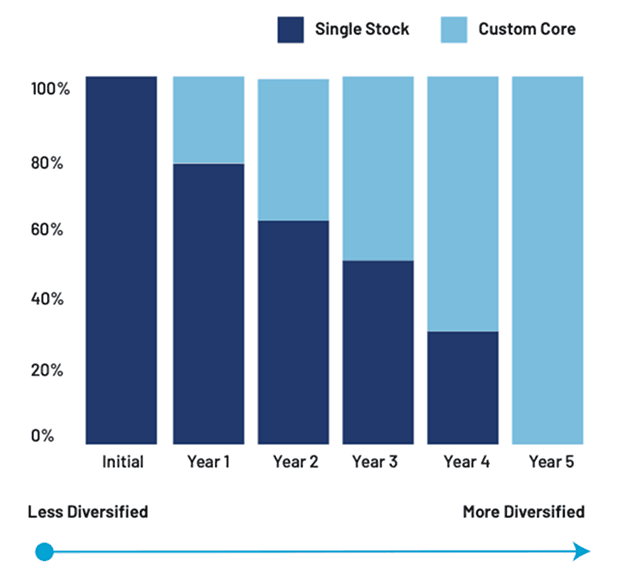
Staged Diversification: Selling company stock provides immediate diversification but may result in significant tax liabilities. Strategies like staged selling or using tax losses in your portfolio to offset tax gains can help mitigate these costs. Staged diversification is a method of gradually reducing a large, concentrated investment position over an extended period. This approach allows investors to unwind concentrated positions in multiple tranches, reducing concentration risk and spreading out the associated capital gains tax liability over several years. This strategy is often paired with tax-loss harvesting, often referred to as "direct indexing".
Direct indexing involves the purchasing of individual stocks that comprise a chosen market index (such as the S&P 500 or Russell 1000) rather than buying an index fund or ETF. This approach aims to replicate the performance of the underlying index while providing access to the individual securities for tax optimization purposes. The methodical and systematic realization of capital losses from individual securities in an investment portfolio to offset current and future capital gains can create significant "tax alpha".
Holistic Financial Planning for Technology Professionals
Ultimately, tax planning should not occur in isolation. It should be integrated holistically with broader financial objectives such as homeownership, education funding, early retirement, philanthropic giving, and legacy goals. A comprehensive approach—ideally in partnership with a financial advisor and tax professional—ensures that compensation decisions support long-term wealth creation, risk management, and legacy planning. Annual tax projections and scenario modeling are invaluable tools for anticipating tax liabilities and identifying planning opportunities.
Retirement Planning: Maximizing Tax-Advantage Growth
For tech professionals, retirement planning is not just about saving for the future—it's a critical component of a broader tax strategy. Leveraging tax-advantaged retirement accounts can significantly reduce current taxable income while allowing investments to grow either tax-deferred or tax-free. Traditional and Roth 401(k) plans offer generous contribution limits, and Roth options are particularly attractive for individuals who anticipate being in a higher tax bracket in retirement. By contributing to a Roth 401(k), employees can benefit from tax-free growth and withdrawals, assuming qualified distribution rules are met. High earners may benefit from strategies such as the Backdoor Roth IRA or the Mega Backdoor Roth, which leverage after-tax contributions and in-plan conversions. Coordinating equity liquidation with retirement contributions can further enhance tax efficiency, especially in years with large vesting or exercise events.
Backdoor Roth IRA
High-income earners may consider advanced strategies such as the Backdoor Roth IRA and the Mega Backdoor Roth IRA. These approaches allow individuals to bypass income limits that would otherwise restrict Roth contributions. The Backdoor Roth IRA strategy involves making non-deductible contributions to a traditional IRA and then converting those funds to a Roth IRA. While the conversion is a taxable event, paying the tax from outside sources—rather than from the IRA itself—helps preserve the full investment value within the retirement account. However, individuals with existing pre-tax IRA balances must carefully navigate the IRS's pro rata rule, which can result in unintended tax consequences if not properly planned.
Mega Backdoor Roth IRA
The Mega Backdoor Roth IRA builds on Roth IRA concept within the framework of an employer-sponsored 401(k) plan. It allows employees to make after-tax contributions beyond the standard deferral limits and convert those contributions into a Roth 401(k) or Roth IRA. This strategy can dramatically increase retirement savings for those with access to plans that support after-tax contributions and in-plan conversions. Not all 401(k) plans offer this flexibility, so employees should consult their plan administrator to confirm eligibility and implementation procedures.
Coordinating equity compensation events—such as stock option exercises or RSU vesting—with retirement contributions can further enhance tax efficiency. For example, in years when an employee realizes significant income from equity, maximizing retirement plan contributions can help offset the tax impact. Strategic timing of equity liquidation alongside retirement funding decisions allows for better control over taxable income and long-term wealth accumulation.
Deferred Compensation Planning: Shifting Income with Intention
For more senior employees and executives in the tech industry, deferred compensation plans offer another layer of tax planning flexibility. Non-qualified Deferred Compensation (NQDC) arrangements allow individuals to postpone income to future years, often aligning with retirement when tax rates may be lower. These plans are particularly useful for managing variable income and smoothing out cash flow over time. However, they come with important considerations. Deferred compensation is subject to the financial health of the employer, meaning the funds are at risk if the company faces insolvency. Additionally, strict compliance with IRS Section 409A rules is required to avoid penalties and immediate taxation.
Thoughtful deferral elections should be made in coordination with projected income needs, retirement timelines, and broader investment strategies. When used effectively, deferred compensation can reduce current tax burdens and support long-term financial goals. However, because of the complexity and potential risks, these plans should be evaluated in the context of a comprehensive financial and tax strategy.
Legacy Planning
Legacy and family gifting strategies are central to preserving multigenerational wealth while optimizing tax efficiency. While households no longer need to anticipate the sunset of the Tax Cuts and Jobs Act (TCJA) in their estate plan, ever-changing life events such as family structures, financial circumstances, and unforeseen health concerns can prompt the need to reassess an estate plan. Outside of ensuring traditional estate planning documents (Wills, POAs, health care proxies, & revocable trusts) are in place, advanced planning opportunities exists such as IDGTs, GRATs, and FLPS, among others to not only reduce estate and gift tax liabilities but also support long-term governance structures that align with family values, succession planning, and wealth stewardship across generations.
Strategic Lifetime Gifting
The federal lifetime gift and estate tax exemption allows individuals to transfer substantial wealth without triggering gift taxes—$15 million per person in 2026 ($30 million for married couples). This exemption represents a powerful wealth transfer opportunity, particularly when used strategically to gift shares that founders expect to appreciate significantly or believe are currently undervalued.
The key to maximizing this strategy lies in timing and asset selection. Gifting appreciated shares can be a lesson in financial literacy for recipient and is an opportunity to discuss the tax consequences of selling. Recipients inherit the donor's original cost basis and holding period. If the stock has significantly embedded gains, the recipient will be responsible for the accompanying tax should they decide to sell. Fortunately, younger recipients who are independent are likely to have a lower capital gains tax rate – possibly even 0% if their income falls within the lowest tax bracket. [1] For donors, the advantage can be twofold: You are not only avoiding capital gain tax recognition, but also removing potential appreciation from your estate.
[1] The kiddie tax applies to full-time student under the age of 24 (at the end of the calendar year) who don't have enough earned income to cover at least 50% of their own living and education expenses. In those cases, unearned income (such as dividend or interest payments from the gifted assets) that exceeds $2,700 in 2026 is subject to their parents' income tax rate.
Annual exclusion gifts ($19,000 per recipient in 2026) can supplement lifetime gifting strategies but represent a smaller component of comprehensive wealth transfer planning. The annual exclusions are particularly useful for systematic transfers to multiple beneficiaries without eroding the lifetime exemption.
Education Planning
529 Plans are state-sponsored tax-advantaged savings accounts designed to fund education expenses. Contributions are made with after-tax dollars, but earnings grow tax-free, and withdrawals are also tax-free if used for qualified education costs making this a powerful tax and estate planning tool. There is no federal annual contribution limit though contributions above the annual gift exclusion ($19,000 for individuals and $38,000 for joint filers) will trigger gift tax consequences. As a workaround, donors can elect five-year gift averaging as known as "superfunding", enabling up to $95,000 of contributions ($190,000 for joint filers) in 2026 without incurring gift tax. Rules vary by state with some states offering tax deductions on contributions and others imposing aggregate caps on account values. Should overfunding be a concern, designated plan beneficiaries can be changed, and beneficiaries may be able to rollover up to $35,000 during their lifetime into a Roth IRA, providing flexibility. Recent changes under the One Big Beautiful Bill Act expanded the definition of qualifying education expenses and withdrawal rules, further enhancing potential benefits.

Epilogue
At PCM Encore, we've seen firsthand how proactive tax planning can transform outcomes—turning a good financial strategy into a great one. The same portfolio, exit, or gifting plan can deliver dramatically different aftertax results depending on how early and intentionally you plan.
This Tax Guide Series represents our approach to sharing that expertise more broadly. Each guide is designed to take a complex topic and break it down into practical, actionable steps that you can implement with your advisors. And we share real-world case studies, including from our own founder, Michael Paulus.
This second edition focuses on successful technology employees and those navigating complex equity compensation structures. We plan to continue this series with guides covering specialized topics for private equity and venture capital partners, multigenerational families, and other high-net-worth investors navigating increasingly complex tax environments.
Our goal with every edition is the same: to help you stay ahead of opportunities, avoid costly missteps, and align your tax strategy with your broader financial objectives. In a world where rules shift quickly and opportunities are fleeting, thoughtful tax planning is essential, especially as it is one of the few areas fully in your control.
Thank you for trusting us to be part of your journey. We hope this series serves as a valuable resource as you build, invest, and plan for what's next.

Head of Tax
General Disclosures
PCM Encore is an investment advisor registered with the U.S. Securities and Exchange Commission (SEC) under the Investment Advisers Act of 1940. Registration with the SEC does not imply a certain level of skill or training. Additional information about PCM Encore, including its services, fees, and disciplinary history, is available at adviserinfo.sec.gov.
This material is provided for informational purposes only and does not constitute an offer to buy or sell any security or financial instrument. All investments involve risk, including the potential loss of principal. Clients and prospective clients should refer to PCM Encore's Form ADV Part 2A (the "Brochure") for a detailed description of services, fees, and conflicts of interest.
Investment Risk Disclosures
Past performance is not a guarantee of future results. All investing involves risk, including the possible loss of principal. Asset allocation and diversification strategies do not guarantee a profit or protect against loss in declining markets.
Indices are unmanaged and provided for illustrative purposes only. Investors cannot invest directly in an index. Index returns do not reflect management fees, transaction costs, or other expenses that would reduce actual performance.
Forward-looking statements and projections are subject to change and may not come to pass. No guarantee is made that any investment strategy or recommendation will achieve its stated objectives.
Legal, Tax, and Estate Planning Disclosures
PCM Encore does not provide tax or legal advice directly. Tax preparation and filing services are provided by PCM Tax, LLC, a separate affiliated entity to PCM Encore, LLC. Clients who engage for tax services will enter into a separate engagement letter with PCM Tax, LLC. Clients are encouraged to consult with their personal attorney, accountant, or tax advisor for matters involving taxation, estate planning, and charitable giving.
PCM Encore may also coordinate with independent third-party professionals for tax planning or estate planning services. While we aim to deliver a seamless and integrated client experience, all tax filing and legal work is conducted by licensed professionals through PCM Tax, LLC or other external providers, not directly by PCM Encore.
Estate planning services—including introductions to third-party estate attorneys or trust administrators—may also be facilitated through these independent professionals. PCM Encore is not affiliated with these third parties and does not guarantee or supervise the services they provide. PCM Encore does not act as a corporate trustee or provide legal representation.
Custody, Lending, and Infrastructure Disclosures
Client assets are held by qualified third-party custodians. PCM Encore does not maintain physical custody of client funds or securities. Clients will receive statements directly from custodians and should review them carefully for accuracy.
PCM Encore may facilitate access to lending, banking, or insurance solutions through unaffiliated third-party institutions, including Morgan Stanley and others. These products are subject to the terms, risks, and underwriting of the issuing institution. PCM Encore does not guarantee the performance of products or services offered by third parties.
Securities-based lending involves risks, including collateral calls and forced liquidation. Such loans may not be suitable for all investors. Borrowing to invest magnifies gains and losses.
Additional Disclosures
PCM Encore acts in a fiduciary capacity for advisory clients. Conflicts of interest and compensation structures are disclosed in our Form ADV. No client personal information will be shared with external service providers without prior written authorization.
Investment advisory services are offered only pursuant to a signed investment advisory agreement and only in jurisdictions where PCM Encore is properly registered or exempt from registration.

Step into a future of financial
clarity and confidence.
Contact us today to inquire about our services or to book an appointment
Local presence, national reach,
unparalleled expertise.

Palo Alto, CA
1881 Page Mill Road
Suite 100
Palo Alto, CA 94304
Bellevue, WA
10900 NE 4th Street
Suite 2300
Bellevue, WA 98004
Aspen, CO
520 E Cooper Avenue
Suite 7C
Aspen, CO 81611
Miami, FL
6th floor #6113
Brickell City Centre
78 SW 7th St
Miami, FL 33130
Richmond, VA
3900 Westerre Parkway
Suite 300
Richmond, VA 23233
New York, NY
430 Park Avenue
New York, NY 10022
LEGAL

The information provided on this website is for educational purposes only and does not constitute investment, legal, or tax advice. It is not an offer to buy or sell any security or insurance product and does not imply endorsement of any third-party services or viewpoints. Links to external content are for informational purposes and should not be construed as endorsements. All examples are hypothetical and for illustrative purposes only; we recommend contacting us for tailored advice based on your individual circumstances.
PCM Encore, LLC does not provide tax or legal advice and encourages you to seek guidance from qualified professionals regarding your specific situation. Any videos available on this site are for educational purposes and do not constitute investment advice. Our current written disclosure statement, as required under Form ADV, detailing our services, fees, and business operations, is available upon request. This website may contain forward-looking statements; actual results may differ due to various risks and uncertainties.
©2026 PCM Encore, LLC, a SEC registered investment advisor. Registration with the SEC does not imply a certain level of skill or training, and results are not guaranteed.
